UserWiki:Richardpruen: Difference between revisions
Richardpruen (talk | contribs) draft reply to DHSC |
Richardpruen (talk | contribs) add letter to DHSC 13 april |
||
| (2 intermediate revisions by the same user not shown) | |||
| Line 103: | Line 103: | ||
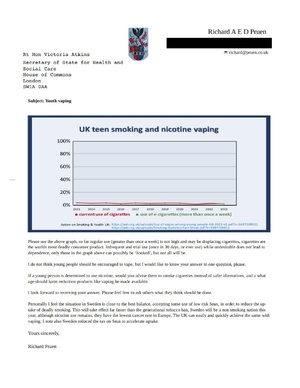
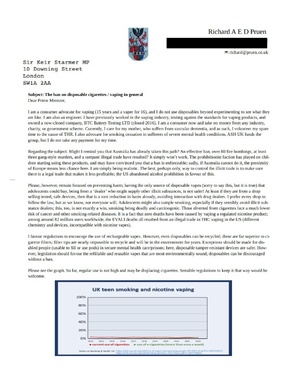
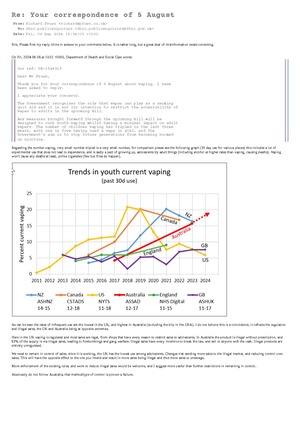
[[File:Email-response-reply-DHSC-26-oct-2024-draft2.pdf.pdf|thumb|alt=Thank you for the reply, please find my response inline. On Thu, 2024-10-24 at 17:26 +0000, Department of Health and Social Care wrote: > Our ref: DE-1529395 <cut> We also remain fully committed to our Swap to Stop scheme, which sees up to one million adult smokers being encouraged to ‘swap to stop’, swapping cigarettes for vapes under the national scheme – the first of its kind in the world. Very glad to hear this, as suggested before I hope you would consider putting extra focus on reaching older cigarette users, they are the group most directly facing health harms, and the generational ban does nothing for them ever. The possibility exists to eliminate a huge amount of disease and death. With savings to the NHS year on year because cancer treatments are expensive. On the subject of the tobacco and vapes bill, I don't see the big rush the likes of ASHuk promote, by the time the legislation has any effect the 2030 smoke free deadline will have passed. IMHO it is better to take the time and get it right, than to rush through damaging regulations. Clive Bates provides good reasons here: https://clivebates.com/uk-tobacco-and-vapes-bill-a-misfire-and-a-backfire/ In addition, NHS programmes delivering nicotine replacement therapy are helping thousands of adults each year to live healthier lives with adult smoking rates dropping by more than half in the last three decades. Good, the more low risk options available the more likely people will find an acceptable one, and thus not die. Whilst vapes can be an effective quit aid for adult smokers, we are concerned about the worrying rise in vaping among children, and there are legitimate concerns about the unknown long-term harms from vaping. There has not been a significant rise in regular use of vapes (once a week or more) certainly nothing sudden or panic worthy. The Please see this graph: With 20 years of use, biomarker data, 16 years of popular use mostly in ex cigarette users, you are vastly overstating the remaining risk. Vaping is not likely to cause cancer of any kind (cancer potential 0.004% of smoking, a robust body of evidence https://safernicotine.wiki/mediawiki/index.php/Nicotine_-_Myth_-_Nicotine_Causes_Cancer) At this stage any possible risks are sure to be minor, the type that may cause discomfort or be annoying, but extremely unlikely to be life threatening. Science has moved on since cigarettes where found harmful, there is also real world population data from Sweden on reduced risk products and the effect. No need for modelling, there has been enough time to see the results in the eurobarometer. Vapes can do the same in the UK, or legalise Snus and copy Sweden, either way would work. As long as the you do not ban the good, while trying to achieve the perfect (resulting the disaster of more cigarettes). Ideally legalise Suns alongside vapes and transition those who will not vape to that, and cut deaths faster. Disposable vapes play a significant role in driving youth vaping with 54 per cent of current vapers aged 11-to-17 in Great Britain using them. They are easily available, cheaply priced and come in enticing colours and flavours. Additionally, they cause significant environmental harm with five million disposable vapes being either littered or thrown away in general waste every week. Given the level of environmental harm, the Department for Environment, Food and Rural Affairs is reviewing proposals to restrict the sale and supply of disposable vapes and will shortly outline its plans. Reusable and refillable products will remain available to help support smokers to switch and we do not have any plans to restrict vapes, for instance, to prescription only channels. There is absolutely no reason to punish the thousands of adults who will be put off from vaping, for 54% of 0.8% (youth vapers who never used cigarettes). Half of those adults not switching will die, while the youth will need to taper off nicotine using refillable vapes built in off ramp, cigarettes do not have that. Meanwhile according to NHS digital 2022 (graph below) 8% of 11-16 year old's have been drunk 3 or more times, vape are very effectively kept out of young peoples hands compared to that. There is no mass moral panic about alcohol, alcohol is far more deadly than vapes You need to sort priorities out, because the evidence doesn't support the focus on vapes. Enforcement of our regulations is vital. This is why we will ensure that the Tobacco and Vapes Bill contains new powers for trading standards, to take more immediate action to prevent the sale of vape to children and stop illicit products. That is great, underage sales need to be kept low, so does the illegal sale of unregulated vapes. In addition to local enforcement action, we are also providing £3million of funding over two years for Operation Joseph to reduce the sale of illegal vapes and nicotine containing vapes to under 18s. Operation Jospeh has been increasing funding at ports to ensure trading standards can conduct large seizures of illicit vapes before they enter the country. Great, but ensuring a legal market of products people want and find acceptable will mean illegal sales are unprofitable, there is also no cost to the government to enforce that. Restricting adults choices of flavours and full plain packaging will result in demand, the proposed sin tax will increase profitability, Australia at the time of writing has had 130 firebombings in the vapes turf war, do not bring that sort of insanity here, learn from their mistakes. Marketing is already restricted, and no reputable company targets underage users, they would be boycotted out of existence by consumers because they will not put up with youth targeting (I have seen this several times and it is very effective). Any genuinely youth appealing marketing or packaging can be dealt with under existing rules against advertising the product. It is while consumers are on side you can rely on this, if like Australia restrictions mean the public support the illegal market, then things will go badly here, just like Australia. I also worry the focus on vaping will detract from youth alcohol and drug prevention. Both these cause significant deaths, vaping doesn't even intoxicate, nor will it cause young people to die. The Department has previously published a call for evidence, a policy paper and a response to the public consultation on tobacco and vaping measures. All of these contain published links to evidence the Government has used in formulating policy and are relevant to many of the points you have raised. In addition to this, we work closely with organisations such as Action on Smoking and Health, public health bodies, academics, local organisations and other relevant parties to ensure that policy is based on the most reliable evidence. With respect it would be best to rely more heavily on the reports that where done for OHID, and less on hearsay or anecdotal evidence that may be brought up in parliament. Views should be heard, but must never take precedence over a report based on evidence and backed by science. We will be undertaking further consultations before the introduction of vaping regulations once the Tobacco and Vapes Bill has completed its parliamentary stages, and I would encourage you to respond to those consultations when they launch. Yes thank you. You can be sure I will be taking part in such consultations where possible. I am however just a consumer and care for my Mum who has vascular dementia, I hope this reply is helpful. Yes thank you, it makes it clear that risk is not an easy concept, and I hope the information presented helps to provide better perspective. Please feel free to ask any questions I will do my best to clarify any points or provide extra evidence if needed. Yours sincerely, Correspondence Officer Ministerial Correspondence and Public Enquiries Department of Health and Social Care --------------------------------------------------------------------- ---------------------------------------------------- Please do not reply to this email. To contact the Department of Health and Social Care, please visit theContact DHSC section on GOV.UK To receive news about DHSC: sign up to our monthly newsletter This e-mail and any attachments is intended only for the attention of the addressee(s). Its unauthorised use, disclosure, storage or copying is not permitted. If you are not the intended recipient, please destroy all copies and inform the sender by return e-mail. Any views expressed in this message are not necessarily those of the Department of Health and Social Care. Please note: Incoming and outgoing email messages are routinely monitored for compliance with our policy on the use of electronic communications. -- Richard Pruen <richard@pruen.co.uk>|Email response to DHSC draft 2]] | [[File:Email-response-reply-DHSC-26-oct-2024-draft2.pdf.pdf|thumb|alt=Thank you for the reply, please find my response inline. On Thu, 2024-10-24 at 17:26 +0000, Department of Health and Social Care wrote: > Our ref: DE-1529395 <cut> We also remain fully committed to our Swap to Stop scheme, which sees up to one million adult smokers being encouraged to ‘swap to stop’, swapping cigarettes for vapes under the national scheme – the first of its kind in the world. Very glad to hear this, as suggested before I hope you would consider putting extra focus on reaching older cigarette users, they are the group most directly facing health harms, and the generational ban does nothing for them ever. The possibility exists to eliminate a huge amount of disease and death. With savings to the NHS year on year because cancer treatments are expensive. On the subject of the tobacco and vapes bill, I don't see the big rush the likes of ASHuk promote, by the time the legislation has any effect the 2030 smoke free deadline will have passed. IMHO it is better to take the time and get it right, than to rush through damaging regulations. Clive Bates provides good reasons here: https://clivebates.com/uk-tobacco-and-vapes-bill-a-misfire-and-a-backfire/ In addition, NHS programmes delivering nicotine replacement therapy are helping thousands of adults each year to live healthier lives with adult smoking rates dropping by more than half in the last three decades. Good, the more low risk options available the more likely people will find an acceptable one, and thus not die. Whilst vapes can be an effective quit aid for adult smokers, we are concerned about the worrying rise in vaping among children, and there are legitimate concerns about the unknown long-term harms from vaping. There has not been a significant rise in regular use of vapes (once a week or more) certainly nothing sudden or panic worthy. The Please see this graph: With 20 years of use, biomarker data, 16 years of popular use mostly in ex cigarette users, you are vastly overstating the remaining risk. Vaping is not likely to cause cancer of any kind (cancer potential 0.004% of smoking, a robust body of evidence https://safernicotine.wiki/mediawiki/index.php/Nicotine_-_Myth_-_Nicotine_Causes_Cancer) At this stage any possible risks are sure to be minor, the type that may cause discomfort or be annoying, but extremely unlikely to be life threatening. Science has moved on since cigarettes where found harmful, there is also real world population data from Sweden on reduced risk products and the effect. No need for modelling, there has been enough time to see the results in the eurobarometer. Vapes can do the same in the UK, or legalise Snus and copy Sweden, either way would work. As long as the you do not ban the good, while trying to achieve the perfect (resulting the disaster of more cigarettes). Ideally legalise Suns alongside vapes and transition those who will not vape to that, and cut deaths faster. Disposable vapes play a significant role in driving youth vaping with 54 per cent of current vapers aged 11-to-17 in Great Britain using them. They are easily available, cheaply priced and come in enticing colours and flavours. Additionally, they cause significant environmental harm with five million disposable vapes being either littered or thrown away in general waste every week. Given the level of environmental harm, the Department for Environment, Food and Rural Affairs is reviewing proposals to restrict the sale and supply of disposable vapes and will shortly outline its plans. Reusable and refillable products will remain available to help support smokers to switch and we do not have any plans to restrict vapes, for instance, to prescription only channels. There is absolutely no reason to punish the thousands of adults who will be put off from vaping, for 54% of 0.8% (youth vapers who never used cigarettes). Half of those adults not switching will die, while the youth will need to taper off nicotine using refillable vapes built in off ramp, cigarettes do not have that. Meanwhile according to NHS digital 2022 (graph below) 8% of 11-16 year old's have been drunk 3 or more times, vape are very effectively kept out of young peoples hands compared to that. There is no mass moral panic about alcohol, alcohol is far more deadly than vapes You need to sort priorities out, because the evidence doesn't support the focus on vapes. Enforcement of our regulations is vital. This is why we will ensure that the Tobacco and Vapes Bill contains new powers for trading standards, to take more immediate action to prevent the sale of vape to children and stop illicit products. That is great, underage sales need to be kept low, so does the illegal sale of unregulated vapes. In addition to local enforcement action, we are also providing £3million of funding over two years for Operation Joseph to reduce the sale of illegal vapes and nicotine containing vapes to under 18s. Operation Jospeh has been increasing funding at ports to ensure trading standards can conduct large seizures of illicit vapes before they enter the country. Great, but ensuring a legal market of products people want and find acceptable will mean illegal sales are unprofitable, there is also no cost to the government to enforce that. Restricting adults choices of flavours and full plain packaging will result in demand, the proposed sin tax will increase profitability, Australia at the time of writing has had 130 firebombings in the vapes turf war, do not bring that sort of insanity here, learn from their mistakes. Marketing is already restricted, and no reputable company targets underage users, they would be boycotted out of existence by consumers because they will not put up with youth targeting (I have seen this several times and it is very effective). Any genuinely youth appealing marketing or packaging can be dealt with under existing rules against advertising the product. It is while consumers are on side you can rely on this, if like Australia restrictions mean the public support the illegal market, then things will go badly here, just like Australia. I also worry the focus on vaping will detract from youth alcohol and drug prevention. Both these cause significant deaths, vaping doesn't even intoxicate, nor will it cause young people to die. The Department has previously published a call for evidence, a policy paper and a response to the public consultation on tobacco and vaping measures. All of these contain published links to evidence the Government has used in formulating policy and are relevant to many of the points you have raised. In addition to this, we work closely with organisations such as Action on Smoking and Health, public health bodies, academics, local organisations and other relevant parties to ensure that policy is based on the most reliable evidence. With respect it would be best to rely more heavily on the reports that where done for OHID, and less on hearsay or anecdotal evidence that may be brought up in parliament. Views should be heard, but must never take precedence over a report based on evidence and backed by science. We will be undertaking further consultations before the introduction of vaping regulations once the Tobacco and Vapes Bill has completed its parliamentary stages, and I would encourage you to respond to those consultations when they launch. Yes thank you. You can be sure I will be taking part in such consultations where possible. I am however just a consumer and care for my Mum who has vascular dementia, I hope this reply is helpful. Yes thank you, it makes it clear that risk is not an easy concept, and I hope the information presented helps to provide better perspective. Please feel free to ask any questions I will do my best to clarify any points or provide extra evidence if needed. Yours sincerely, Correspondence Officer Ministerial Correspondence and Public Enquiries Department of Health and Social Care --------------------------------------------------------------------- ---------------------------------------------------- Please do not reply to this email. To contact the Department of Health and Social Care, please visit theContact DHSC section on GOV.UK To receive news about DHSC: sign up to our monthly newsletter This e-mail and any attachments is intended only for the attention of the addressee(s). Its unauthorised use, disclosure, storage or copying is not permitted. If you are not the intended recipient, please destroy all copies and inform the sender by return e-mail. Any views expressed in this message are not necessarily those of the Department of Health and Social Care. Please note: Incoming and outgoing email messages are routinely monitored for compliance with our policy on the use of electronic communications. -- Richard Pruen <richard@pruen.co.uk>|Email response to DHSC draft 2]] | ||
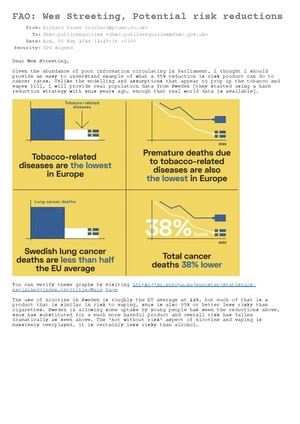
[[File:Email-dhsc-20-nov-2024.pdf|thumb|alt=Hi folks, Since the government promised to be evidence led, I thought this new evidence was vital for vaping policy. In this paper the authors examined respiratory symptoms in e-cigarette users without a history of smoking from the VERITAS cohort. While vapers reported slightly more frequent symptoms than non-vapers on the Respiratory Symptom Experience Scale, the difference was not clinically significant. Disposable e-cigarettes were the most common device type, with fruit flavors preferred by most users. https://www.nature.com/articles/s41598-024-80221-8 The VERITAS cohort https://veritascohort.coehar.org/ aims to provide long term data on vaping in never cigarette users <100 cigarettes in their life, and is important because most vapers are past cigarette smokers and significant confounding exists due to this. The first data above shows 'the difference between groups was not clinically significant', further proof that in the long term, vaping is vastly safer than smoking, and the effects on non-smokers are tiny, not clinically significant. It is vital that you factor this information into policy because adults who are convinced not to switch face death 50% of the time. Adolescent nicotine use is falling, and if they do use any product, then smoking should be the least available to them, as it is the most harmful. Vaping in adolescents is lower than alcohol use, and alcohol is far more toxic in both the short and long term. The current age of sale laws means the UK has the lowest regular use of vapes in underage in the world; we should keep doing that, but be aware that there is little harm from vaping when you compare that to the death faced by cigarette smokers. The tax and ban policy will not work; it will lead to illegal markets, just like Australia has seen; once control is lost, it will be harder to regain. Sweden, on the other hand, did not reduce nicotine use, which is average for the EU, but has seen reductions in smoking-related diseases and cancer. They have also achieved the smoke-free goal 17 years early: The UK will reduce death and disease more rapidly being more like Sweden than like Australia. I would like you to focus on reducing death and disease quickly, and without sacrificing the older cigarettes smoking population, this is possible, if Sweden can do it, so can the UK. Thank for your time. -- Richard Pruen <richard@pruen.co.uk>|Email to DHSC 20 nov 2024]] | |||
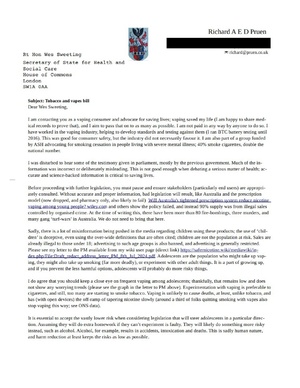
DRAFT: [[File:Letter minister for health 11th Feb 2025.pdf|thumb|alt=Subject: Ongoing Vaping Policy Dear Ashley Dalton, I am contacting you as a vaping consumer and advocate for saving lives; vaping saved my life (I am happy to share medical records to prove that), and I aim to pass that on to as many as possible. I am not paid in any way by anyone to do so. I have worked in the vaping industry, helping to develop standards and testing against them (I ran BTC battery testing until 2016). This was good for consumer safety, but the industry did not necessarily favour it. I am also part of a group funded by ASH advocating for smoking cessation in people living with severe mental illness; 40% smoke cigarettes, double the national number. I was disturbed to hear some of the testimony given in parliament. Much of the information was incorrect or deliberately misleading. You must do better when debating a serious health matter; accurate and science-backed information is critical to saving lives. You should use the research OHID paid for using taxpayers' money, not anecdotal (often second-hand) accounts from teaching staff or parents frightened by the media. Consumers are not represented; I would ask you to consider involving NNA (New Nicotine Alliance) as they are a consumer-only group that is not funded by the industry. info@nnalliance.org Charity Registration Number: 1160481. It seems fair since UKVIA (industry trade association) and tobacco control NGOs were involved, but there was no one for consumers. Sadly, the media is almost all negative and presents harm because that sells papers; the truth is that in 12 years of monitoring by the MHRA yellow card early warning system, not one single disease/symptom has been detected as linked to vaping nicotine. There have been less than 20 admissions to hospital per year, and none fatal, compared to 15 per day for household cleaners (some sadly fatal). I agree that you should keep a close eye on frequent vaping among adolescents; thankfully, that remains low and does not show worrying trends (see graphs below). Experimentation with vaping is preferable to cigarettes, and still, too many are starting to smoke tobacco. Unlike tobacco, vaping is unlikely to cause deaths since 20 years of study shows no such issue. Vaping has (with open devices) the off-ramp of tapering nicotine slowly (around a third of folks quitting smoking with vapes also stop vaping this way; see ONS data that you must have access to). It is essential to accept the vastly lower risk from vaping when considering legislation that will steer adolescents in a particular direction. Assuming they will do extra homework if they can’t experiment is faulty. They will likely do something more risky instead, such as alcohol. Alcohol, for example, results in accidents, intoxication and deaths. This is sadly human nature, and harm reduction at least keeps the risks as low as possible. It is also vital to ensure that illicit vapes and illegal tobacco sales are kept to a minimum; buying vapes from ‘dealers’ opens all manner of unwanted possibilities, including other more harmful illegal drugs offered at the same time. Thus, great care is needed to avoid a ban on a product type resulting in supply shifting to criminal-controlled illicit sales. Australia is a perfect example of open gang war and fire bombings. A legally regulated market that renders illegal supply unprofitable is the best solution; there is no enforcement cost in that case, and consumers should be protected against entirely unregulated products. In Sweden, the use of nicotine is about the same as in the EU as a whole, but the rates of cancer are lower, particularly in men, since they switched earlier, and the trend is now apparent in the data. It is worth looking at Sweden because it has had a harm-reduction product for a long time, and trends and population data are readily available. It is obvious that nicotine is not the problem; combusted tobacco is the killer, particularly cigarettes; switching existing users to safer products is the priority; you can save vast numbers of lives and treatment costs. I suggest you research the history of THR in Sweden, allowing users to initiate nicotine use with a safer product works; they have the lowest cancer rates in the EU by a good margin. (see the following graphs) The UK can still do the same with vaping by not restricting it too much. Yours sincerely, Richard Pruen|Letter minister for health 11th Feb 2025]] | |||
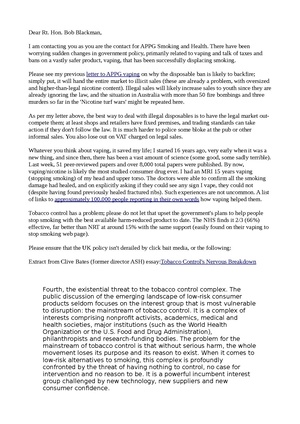
[[File:20250413114422 Cigarettes and Big tobacco.pdf|thumb|alt=I thought this Sobering analysis of the US cigarette market might be interesting. It looks like Big Tobacco is winning, while the only successful commercial alternative (vaping and other THR (tobacco harm reduction) products like tobacco-free pouches) are being further restricted. The UK is falling into the same trap. "Last August Barclays analysts updated the data to show how US cigarettes had become massively more profitable. Based on that Goldman Sachs report this week, the ever-accelerating price increases since last August will bring the gross profit on a pack of Marlboros to $4.50 and the operating profit to around $3.64. More than doubling profits per pack in less than five years, and on a product that costs a mere 40 cents to make." The entire report by David Sweanor, a well-known tobacco control expert from Canada, is attached. While no one wants young people to take up vaping, it is far more vital that they do not start smoking cigerettes. Youth vaping once a week or more is low and remains so (please see graph) The current government plans for a smoke-free generation will not help anyone currently smoking cigarettes; they also have the significant downside of forcing any young people insisting on using nicotine into the illegal market; the sin tax on legal vaping will mean the cheapest/most available product they encounter will be illegal cigarettes, likely they will use those. As we are well aware, cigarettes are not safe, and they are not better than vaping. Despite the ridiculous claims of the press and the rubbish spouted in Parliament, vaping has not been linked to any disease or syndrome. Twelve years of MHRA early warning monitoring would have detected anything serious (that is the reason for its existence). The data is available here: https://safernicotine.wiki/mediawiki/index.php/MHRA_yellow_card (or ask the MHRA). This government promised to be evidence-led, so please look at the evidence and do that. The overabundance of caution to prevent youth vaping will cause more youth to start smoking cigarettes, and that cannot be a good thing; it will cost lives. I would ask you to consider carefully because THR can save at least some of those lives. It may not be perfect or easy to regulate, but lives are important. I do not want to be able to say 'I told you so', I would much rather you did better and saved more lives, please! |Letter to DHSC 13 April 2024]] | |||
Latest revision as of 16:31, 13 April 2025
| Babel user information | ||
|---|---|---|
| ||
| Users by language |
The Site admin
Richard Pruen
Electrical and electronic engineer
Favorite band: Rush
Why spend so much time on this? It’s a fact that nicotine harm reduction (vaping and Snus) saved my life, this is my way to pay that forward, and pass along information on safer nicotine.
Running a site from the ground up, has proved interesting and worthwhile. Some of the things I have learned about Linux, and configuration of software for servers is only stuff you learn by doing.
I suspect the site will stick around, at least as long as it is required to provide links and info.
I might well put more info of my vaping / thr story here soon, this is just a test edit.
More test edit, and added some features, like babel to indicate users languages.
Site admin at Safer nicotine wiki.

ABOUT
Ecig user since 2008, consumer advocate for vaping and THR #VapingSavedMyLife #VapingSavesLives
Twitter @pruenrichard
Below are letters and documents sent in advocacy efforts as a record and should anyone wish to use them for ideas. These are my efforts and do not necessarily reflect the views of the wiki or other users.

![Response ID ANON-EJTE-W3QH-B Submitted to Proposed reforms to the regulation of vapes Submitted on 2023-09-08 21:15:44 Survey contents Privacy and your personal information I consent to the TGA collecting the information requested in this survey about me, including any sensitive information, for the purposes indicated above. Agree: Yes Acknowledgement I agree. Yes.: Yes Introduction 1 What is your name? Name: Richard Pruen 2 What is your email address? Email: richard@pruen.co.uk 3 What is your organisation name? Organisation name or N/A: n/a 4 Please choose a stakeholder group that best describes you or your organisation. Others* *If other, please specify:: Consumer 5 Which best describes your response? I am responding as an individual. 6 Are you an authorised prescriber? No (please go to next page Conflicts of interest (actual or perceived) 1 Have you or your organisation ever received services, assistance or support (whether monetary or non-monetary in nature) from the tobacco industry and/or e-cigarette industry? If this scenario applies to you or your organisation, please provide relevant details in the textbox. Yes If you have selected yes, please provide details here. Otherwise, please state 'Not Applicable':: I owned a company testing electronic cigarettes for compliance with UK and other standards, as well as carried out investigations of failures including battery failure. I also worked on R&D and provided consulting services on for example battery protection circuits, chargers etc. Payment was from user fees for testing, government agencies (trading standards), trade associations, and sometimes individuals or companies carrying out due diligence testing or failure mode analysis. Ended 2016 since then I have been a consumer only and have not received any funding from any company (of any sort), government agency, or researchinstitution. 2 Have you or your organisation ever provided services, assistance or support (whether monetary or non-monetary in nature) to the tobacco industry and/or the e-cigarette industry? If this scenario applies to you or your organisation, please provide further information in the textbox. Yes If you have selected 'yes', please provide details here. Otherwise, please state 'Not Applicable': I assisted in writing standards for UK vaping products (PAS 54115 A guide for the importation and sale of electronic cigarettes and directly related products, with product safety testing methods) and proposed an IEEE standard project number P2800. Several sampling machines were supplied to others testing electronic cigarettes, and other custom test equipment, the supplied equipment presumably used to carry out tests on electronic cigarettes as designed. As academic and test houses purchased this equipment it is assumed this was paid for by test fees, or grants to carry out tests on electronic cigarettes, again possibly linked to taxes etc from tobacco and or electronic cigarette sales. The same funding source as government agencies, politicians and others working in the field. Again since 2016 I have been a consumer only. Proposal 1 -Restrictions on importation, manufacture and supply of all vapes . 1 Do you support the proposed approach to ban disposable single use vapes absolutely and all other vapes, except those for legitimate therapeutic use in compliance with the TG Act? No 2 How would you anticipate industry and consumers to respond to a ban on the importation, manufacture and supply of non-therapeutic vapes? * Please provide answer here. : Demand will remain, along with the risk of vaping being seen as cool because it is something disallowed. The tightening of rules is unlikely to be enforceable, so illicit supply will continue to be the primary supply to the population. The population know vaping is safer than smoking, thus it will be very difficult to curb demand. Prohibiting drugs such as cocaine and cannabis fails, vaping prohibition will almost certainly follow the same pattern. 3 Do you support removal of the personal importation scheme exception for vapes? If not, what would be the impact on you? No (* if not, what would be the impact on you?) * What would be the impact on you?: Vaping products that are acceptable and usable are likely to only be available via illicit sales, and criminal gangs. Particularly as research shows flavours to be vital for the prevention of release to smoking. These products will not be tested or regulated in any way, importing allows users who have a prescription to import what they need to stay smoke-free, thus not relapse to smoking and potentially death. Importantly importing from somewhere with a regulated legal market, they can be sure of the quality and contents of the products they buy. The one-size-fits-all approved vapes that consumers will find at pharmacy outlets is unlikely to be effective since most of the features that make an effective substitute for cigarettes will be regulated out. 4 Do you agree with the proposal to retain a traveller’s exemption, including the proposed limits? Yes 5 Do you support the proposed approach to prohibiting the advertisement of all vapes (subject to limited exceptions)? No 6 [If applicable] Suppliers, what part of supply chain do you occupy? Not applicable * Other -specify your role in supply chain.: Consumer 6 (a) What proportion of your sales volumes is attributable to vape sales [i.e. quantity of vapes sold]? Please provide details here: (or mark Not applicable).: N/A6 (b) What proportion of your sales revenue is attributable to vape sales [i.e. revenue earned from sales]? Please provide details here: (or mark Not applicable).: N/A 6 (c) What impact would the proposed measures have on your sales volumes? Please provide details here: (or mark Not applicable).: not a vendor, none 6 (d) What impact would the proposed measures have on your sales revenues? Please provide details here: (or mark Not applicable).: none not a vendor 6 (e) What proportion of your vapes sales is attributable to disposable single use vapes versus refillable products? Please provide details here: (or mark Not applicable).: not a vendor 6 (f) How would restricting the importation, manufacture and supply of disposable single use, and non-therapeutic, vapes in Australia impact you? Please provide details here: (or mark Not applicable).: not a vendor N/A 6 (g) How much stock do you have in Australia currently and how long would it take to sell that stock? Please provide details here: (or mark Not applicable).: not a vendor N/A 6 (h) What would be the cost to you if you were required to dispose or otherwise move on existing stock? Please provide details here: (or mark Not applicable).: N/A Proposal 2 -Changes to market accessibility requirements, including better regulation of device components. 7 Do you support the approach to require a pre-market notification of compliance with TGO 110? No 8 [If applicable] For suppliers of therapeutic vapes, what impact would the proposed notification system have on your supply model and what transition period would you require to comply with the new notification requirement? Please provide details here: (or mark Not applicable).: not a vendor 9 Do you support the proposed access to vapes under the SAS C notification system? No 9 (a) What impact would this pathway have on facilitating patient access to therapeutic vapes? Please provide details here: (or mark Not applicable).: Vaping works in the rest of the world as a product substitute, providing a safer alternative to a deadly (cigarettes) product. In the UK and NZ smoking decline has accelerated significantly past that in Australia, due to the adoption of consumer vaping, slightly less so in the US where the regulator is not so certain. The prescription model in Australia has failed, smoking has not continued to decline and may have increased possibly. Vaping is also higher in Australian youth than UK and NZ, the current policy has backfired and should be reversed. It is absolutely obvious at this point that unless you have unlimited resources for enforcement, the current policy is not workable, and never will be. The time has come to use what has worked elsewhere and start again.10 [If applicable] For prescribers, would the proposed new pathway likely change your approach to prescribing therapeutic vapes? How? Not a prescriber of vapes * How new pathway will change your approach to prescribing ttherapeutic vapes?: 11 [If applicable] For prescribers, which access pathway (SAS B, SAS C, or AP) would you envisage using to prescribe therapeutic vapes? Why? Not a prescriber of vapes Please tell us why: 12 [If applicable] For prescribers, would integration of SAS or AP applications or notifications into existing clinical software systems ease the administrative burden and/or encourage you to use the new pathway? Not a prescriber of vapes 13 Do you agree with the proposal to regulate both e-liquid and device components of unapproved vapes under the same part of the TG Act for simplicity? No 14 Will these changes have direct or indirect impact on you? Please provide details. Yes (please provide details below) Please provide details here:: As a consumer I want safer options to be available to me and to every person who smokes tobacco or would smoke tobacco for lack of a viable alternative. Sadly some kids will do adult things even if you try to stop them (for example drinking alcohol, unsafe sex, taking drugs, smoking) while they should not be encouraged to vape, it still offers a harm reduction if it diverts them from smoking, like it or not, this is true because safer is safer. 15 Do you require time to adjust to these requirements? If yes, how long? Yes 15 (a) How long do you require to adjust to these requirements? More than 12 months Proposal 3 - Improving quality standard for unapproved (unregistered) vapes) 16 Are the definitions of nicotine and mint flavours appropriate? If not, please provide reasons. No (* please provide reason below) * Please provide reason here.: Nicotine itself does not have a flavour, the flavour should be correctly referred to as "artificial tobacco flavour" There is no evidence that human flavour preference varies by age and none particularly that it changes at 18. It is therefore impossible to target age groups with specific flavours, thus limiting flavours on this basis has no merit whatsoever. 17 Do you agree with the proposed upper limit on the concentration of menthol in vapes? If not, please provide reasons. No (* please provide reason below) * Please provide reason here: It is trivial to add menthol to vapes, this simply encourages users to add more if they prefer, opening a can of worms and the potential for contamination or incompatible ingredients. This seem unwise for very little if any benefit. 18 [If applicable] Importers, manufacturers and suppliers, would the restrictions on flavour proposed above impact you? Not applicable 19 Do you agree with the proposal to require pharmaceutical-like packaging and presentation for vapes, e.g., vapes manufactured in black, white or grey coloured materials, predominantly white background on packaging, clear warning statements and other restrictions on labels in addition to other selective TGO 91 requirements for vapes? No (* please provide reason below)20 [If applicable] What impact will the labelling and packaging changes have on you? * Please provide detail here.: It will probably backfire, making legal products undesirable is likely to increase the number of people using illicit products, particularly if access remains easy, without enforcement that is most likely to be the case. 20 (a) How long would you need to transition your product to comply with the proposed requirements? More than 12 months 21 Do you agree with our approach to allow only permitted ingredients in vapes, instead of trying to prohibit individual chemical entities from use in e-liquids? No 22 [If applicable] Importers, manufacturers and suppliers, will your therapeutic vapes need any re-formulation or other changes to comply with the permitted ingredients and ingredient quality requirements? Not applicable 22 (a) If product re-formulation is required, how long will you need to make these changes? More than 12 months 22 (b) If product re-formulation is required, what financial or business impacts would be associated with them? Provide detail here or put 'Not Applicable': Not a vendor 23 Do you support applying the same regulatory controls to zero-nicotine therapeutic vapes, as for NVPs? No 24 What is the overall business cost on you to comply with a strengthened TGO 110? Please provide details here: (or mark Not applicable).: not a vendor 25 Do you agree with the proposed requirements under TGO 110 that will apply to unapproved device components of vapes? No 26 [If applicable] Suppliers, do you intend to register any vaping device on the register as an approved medical device? No (if no, why not?) If no, why not?: not a vendor 27 [If applicable] Importers, manufacturers and suppliers, are you familiar with relevant US FDA, or MHRA guidance and/or EU standards covering vaping devices? Not applicable 27 (a) Do your vapes currently comply with relevant US FDA, or MHRA guidance and/or EU standards covering vaping devices? Not applicable 27 (b) If not, what requirements do you meet? What requirements you currently comply with?: not a vendor 27 (c) How long would it take to achieve compliance with relevant standards? More than 12 months28 [If applicable] Importers, manufacturers and suppliers, are your vapes manufactured at facilities that hold relevant international standards for Quality Management Systems, such as ISO9001 or ISO 13485? Not applicable Proposal 4 - Strengthening domestic compliance and enforcement mechanisms 29 Do you have any other comments in relation to this proposal? Yes (* provide your comments below) Comments: I reiterate that Australian policy has failed, and further moves in the same direction are likely to fail. Other countries have shown much more desirable results, the best results on smoking have been where vaping has been accepted as a consumer alternative to smoking, but the prescription model, unfortunately, has proven unworkable. Realistically you should review the past responses to enquiries, select a number of people who have successfully predicted the results of current regulations, and ask them for solutions. At least they have a track record, and proven knowledge of the real world and likely outcomes. Supplementary questions 30 [If applicable] Suppliers, please confirm if you intend to continue to supply therapeutic vapes under the proposed reforms described? Not applicable * Product range : Not a vendor, but as a consumer, I can see vendors dropping out. This will benefit the criminals and gangs who supply illicit markets, more trade for them. 30 (a) How long would it take to meet the new requirements? More than 12 months 31 [If applicable] Suppliers, please confirm if you intend to register your therapeutic vapes in the next 2 years? Not applicable What guidance and/or clarity of supporting data requirements do you need from TGA: not a vendor Publication of submissions To proceed, please select from the options below how you would like the TGA to deal with your submissions: I agree to the TGA publishing my response in full. I request the TGA to consider redacting sensitive commercial information from my response before publication: No Please specify sensitive commercial inforation you want redatced :](/mediawiki/images/thumb/8/8b/TGA_consult_8-sept-2023_my_response.pdf/page1-300px-TGA_consult_8-sept-2023_my_response.pdf.jpg)

![Subject: COP 10 WHO FCTC Dear Rosanna O’Connor, I am a consumer advocate for vaping, and do not use disposables beyond experimenting to see what they are like. I am also an engineer. I have worked in the vaping industry previously testing compliance with the standards for vaping products, and owned a now closed company BTC Battery Testing LTD (closed 2016). Currently I care for my mother who suffers vascular dementia, and as such volunteer my spare time to the cause of Tobacco Harm Reduction. I believe that consumers should be present at the COP 10 meeting, it is consumers who have the most to gain from stopping the use of combustible tobacco, and the lived experience of trying to do so. Many millions have found a way to eliminate almost all the risk via THR products. The phrase ‘Nothing about us without us’ springs to mind. Why then are the public and press excluded. I would like to see the proceedings live streamed, so those effected can see what is being done. In no way could this effect the discussions, thus is reasonable transparency. I would like an answer regarding the possibility, please. Many countries already found harm reduction useful, critical even. Be that low risk Snus (Sweden has the lowest cancer rate in Europe, and will be smoking free this year (>5%)). Vaping that the UK NHS finds almost 66% effective with support, as stated on their website. New Zealand has seen similar results, especially in native populations, reducing disparities. Japan has seen huge drops in cigarette sales due to reduced harm heated tobacco products. Please see the letter from the Lancet from Robert Beaglehole and Ruth Bonita. They were both senior officials at WHO and are now at the University of Auckland. Robert was formerly Director of the Department of Chronic Disease and Health Promotion at WHO. Ruth was formerly the Director of Surveillance in the Noncommunicable Disease Cluster at WHO. I wish to add my support for their recommendations, the article is attached (also link here https://doi.org/10.1016/S0140-6736(24)00140-5) please make sure these points are discussed at the COP 10 meeting. Yours sincerely, Richard Pruen P.S Please ensure the representatives listed on the next page can discuss before the metting and forward more widely if you agree with the sentiment. Katherine Sands Tobacco Control Team Leader Department for Health and Social Care Martin Dockrell Tobacco Control Programme Lead Department for Health and Social Care Alison Walker Senior Tobacco Control Policy Lead Department of Health and Social Care Esther Lawrence Deputy Head of Global Health UK Mission to the UN, Geneva Please find attached a letter from [THELANCET-D-24-00371] S0140-6736(24)00140-5](/mediawiki/images/thumb/4/4f/Letter_to_cop_10_repersentitives.pdf/page1-300px-Letter_to_cop_10_repersentitives.pdf.jpg)



DRAFT:

